


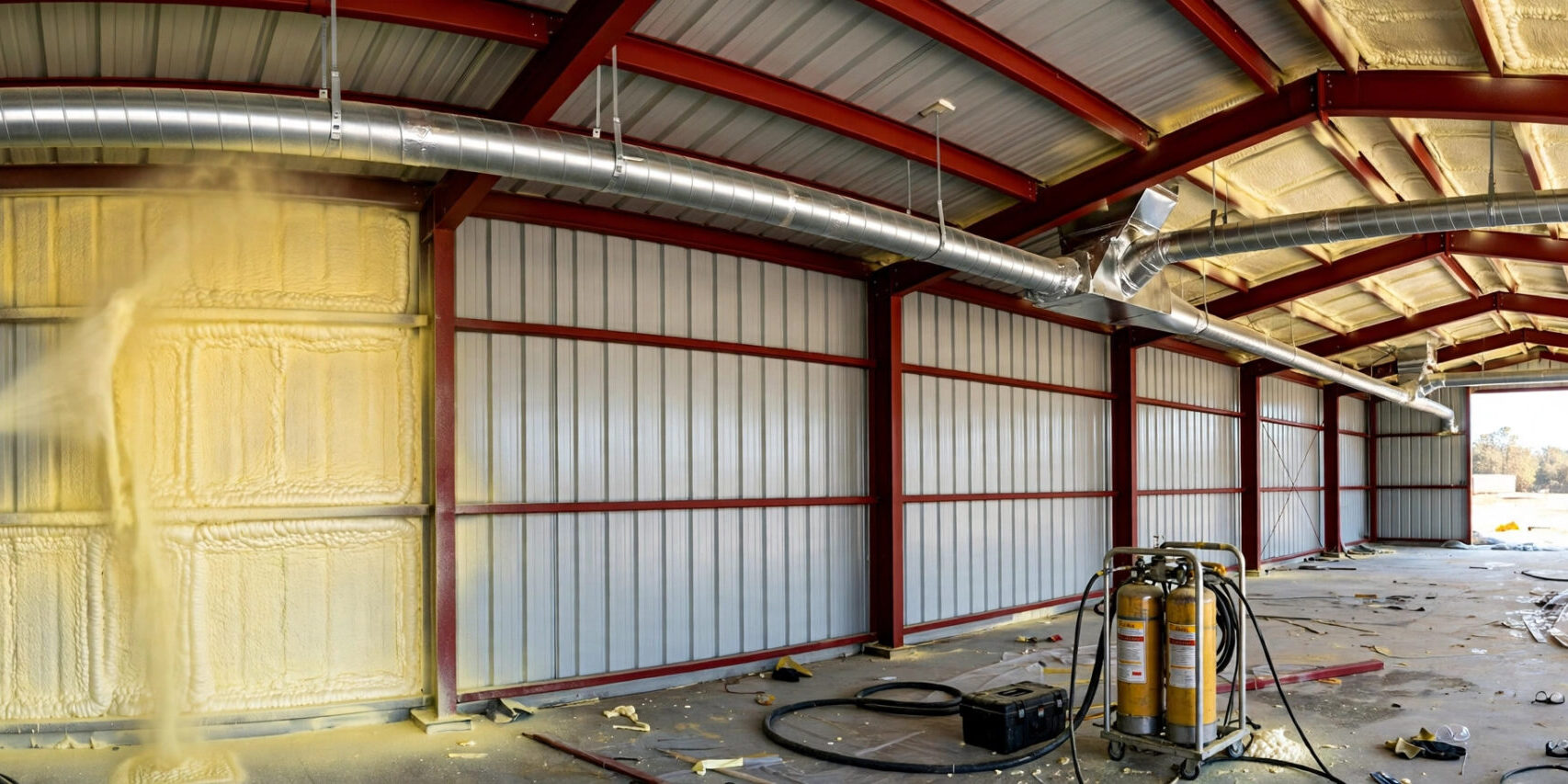
A metal barndominium in the Midwest has to handle humid summer heat, cold winter nights, wind-driven air leakage, and condensation risk at steel panels, girts, purlins, and columns. The best insulation is therefore a system: it should slow heat flow, seal air, control vapor, reduce thermal bridging, and support the HVAC design. Closed-cell spray foam, open-cell spray foam, and fiberglass batts can all work in the right assembly, but they do not solve the same problems.
Closed-cell spray foam is usually the strongest choice directly against metal because it combines high R-value per inch with air sealing and vapor retardation at sufficient thickness. Typical closed-cell foam is around R-6 to R-7 per inch, and at roughly 1.5 to 2 inches it can perform as a Class II vapor retarder, which helps keep warm indoor air from reaching cold steel.
That matters in a barndominium because steel conducts heat quickly and can become a condensation surface when indoor air is humid. Closed-cell foam sprayed to the metal and around framing helps create a continuous thermal break, but it costs more, can limit drying if the assembly is detailed poorly, and still needs the required thermal or ignition barrier in occupied spaces.
“In a metal home, insulation has to stop air and condensation at the steel—not just fill a cavity.”
– Barndominium Builders Kansas City
Open-cell spray foam is softer, lighter, and typically around R-3.5 to R-4.2 per inch. It can air-seal when installed thick enough and is often better for sound absorption in interior walls, bedrooms, offices, and media spaces. Its weakness on metal is vapor: open-cell foam remains vapor-permeable, so a roof or wall assembly may need a separate vapor-control strategy and careful condensation analysis before it is used against cold steel.
“Fiberglass can work, but only when the vapor retarder, air sealing, and thermal breaks are continuous.”
– Insulation note
Fiberglass batts are familiar and usually lower cost, but batts alone do not air-seal and they do not stop steel girts, purlins, and columns from bridging heat through the wall or roof. Compression, gaps, sagging, and torn facing reduce performance, especially in metal-building cavities that are deeper or less regular than wood stud bays.
A batt system needs a continuous vapor retarder where required, sealed seams and penetrations, and a thermal-break strategy such as continuous rigid insulation or a hybrid foam-and-batt assembly. Without those details, the nominal batt R-value can look fine while the finished barndominium still feels drafty, sweats at steel, or costs more to heat and cool.
HVAC sizing should be calculated after the envelope is chosen, not guessed from square footage. A tighter, better-insulated barndominium may need smaller equipment, but it also needs proper ventilation, humidity control, duct design, and load calculations for the actual wall, roof, window, slab, and shop-to-living layout.
For most conditioned red-iron barndominiums near Kansas City, closed-cell foam at the metal envelope, open-cell foam selectively for sound and interior cavities, and batts only as part of a detailed hybrid system is the practical ranking. If you are comparing insulation bids, call Barndominium Builders Kansas City at 816-289-2932 and price the whole envelope, not just the insulation line item.